


Introduction
Bangkok is home to over 400 Buddhist temples, and they are not interchangeable. Each Bangkok temple in Thailand carries its own history, its own sacred objects, and its own spiritual speciality, Thais often choose which temple to visit based on what they are seeking: protection, love, wisdom, career success, or healing.
For international visitors, Bangkok’s temples offer something beyond the visual spectacle of gilded spires and intricate murals. They are living religious spaces, visited daily by working Thais, not just tourists, and understanding why each temple matters gives a deeper experience than photos alone can offer.
This guide covers 6 of Bangkok’s most significant temples: what makes each one special, what Thais traditionally pray for there, and how to get there using the ThaiGo Day Pass.
Dress code for all Bangkok temples in Thailand: Shoulders and knees must be covered. Shoes are removed before entering all buildings. Loose cotton or linen is recommended for comfort in the heat. Sarong rentals are available at the major temples for visitors who arrive underdressed.
6 Essential Bangkok Temples in Thailand
1. Wat Phra Kaew: Temple of the Emerald Buddha
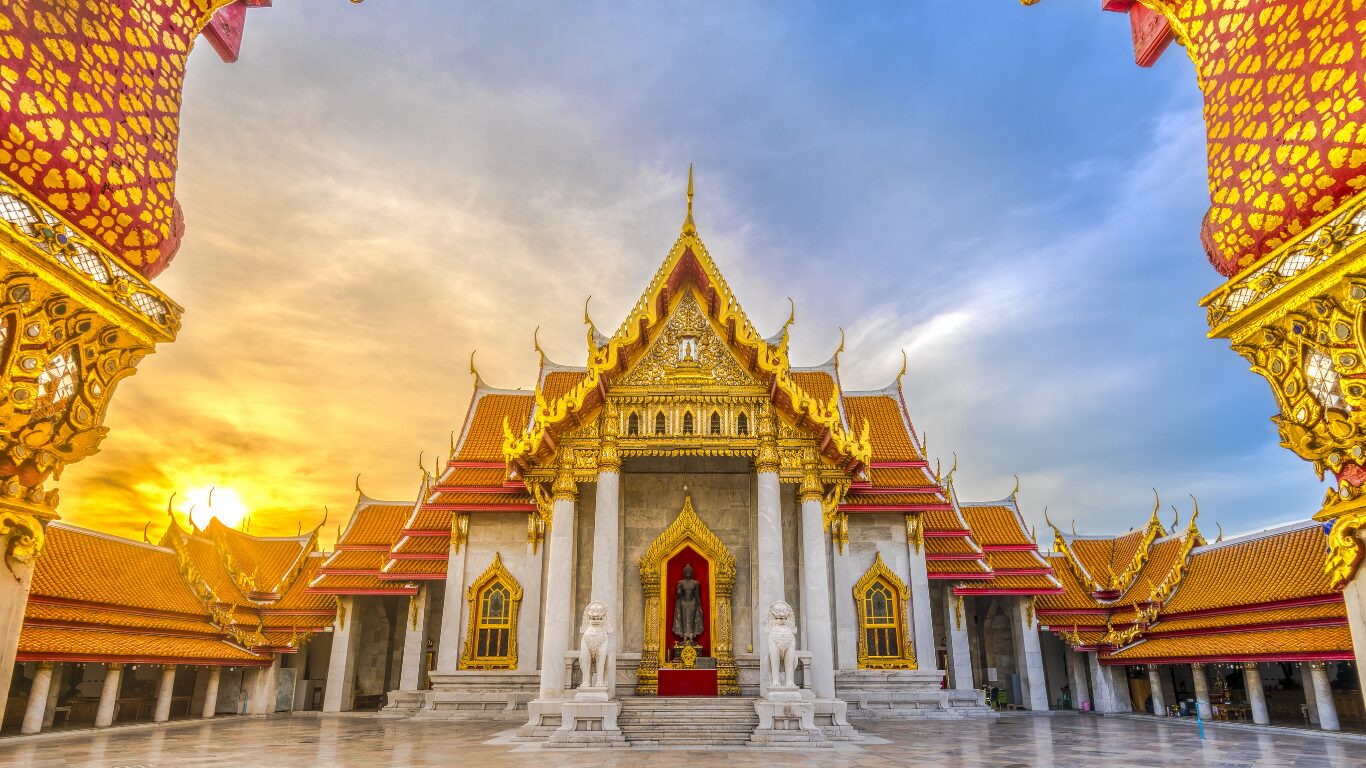
Inside the Grand Palace walls, Phra Nakhon
Wat Phra Kaew is Thailand’s most sacred temple, the spiritual heart of the kingdom. The Emerald Buddha housed inside is not actually emerald but carved from a single piece of green jasper, approximately 66cm tall. The statue has been dressed by the Thai king himself at the change of each season (summer, rainy, and cool) since the time of Rama I, a ritual that continues today.
The surrounding cloister walls are painted with 178 panels of murals depicting the full Ramakien epic (Thailand’s version of the Hindu Ramayana). The architectural detail throughout the complex is extraordinary, each surface is gilded, mosaic-inlaid, or carved.
- Opening hours: 8:30am–3:30pm daily
- Entry fee: 500 THB
- Address: Na Phra Lan Road, Phra Nakhon, Bangkok
- Google Maps: Get Direction
What Thais pray for here: Success, prosperity, and blessings from the highest levels of royal and spiritual authority. This is where significant life intentions are made, career milestones, family wellbeing, national affairs.
Getting there with ThaiGo Day Pass: Thai Smile Boat to N9 (Tha Chang Pier), 3-minute walk to the Grand Palace main gate.
2. Wat Pho: Temple of the Reclining Buddha
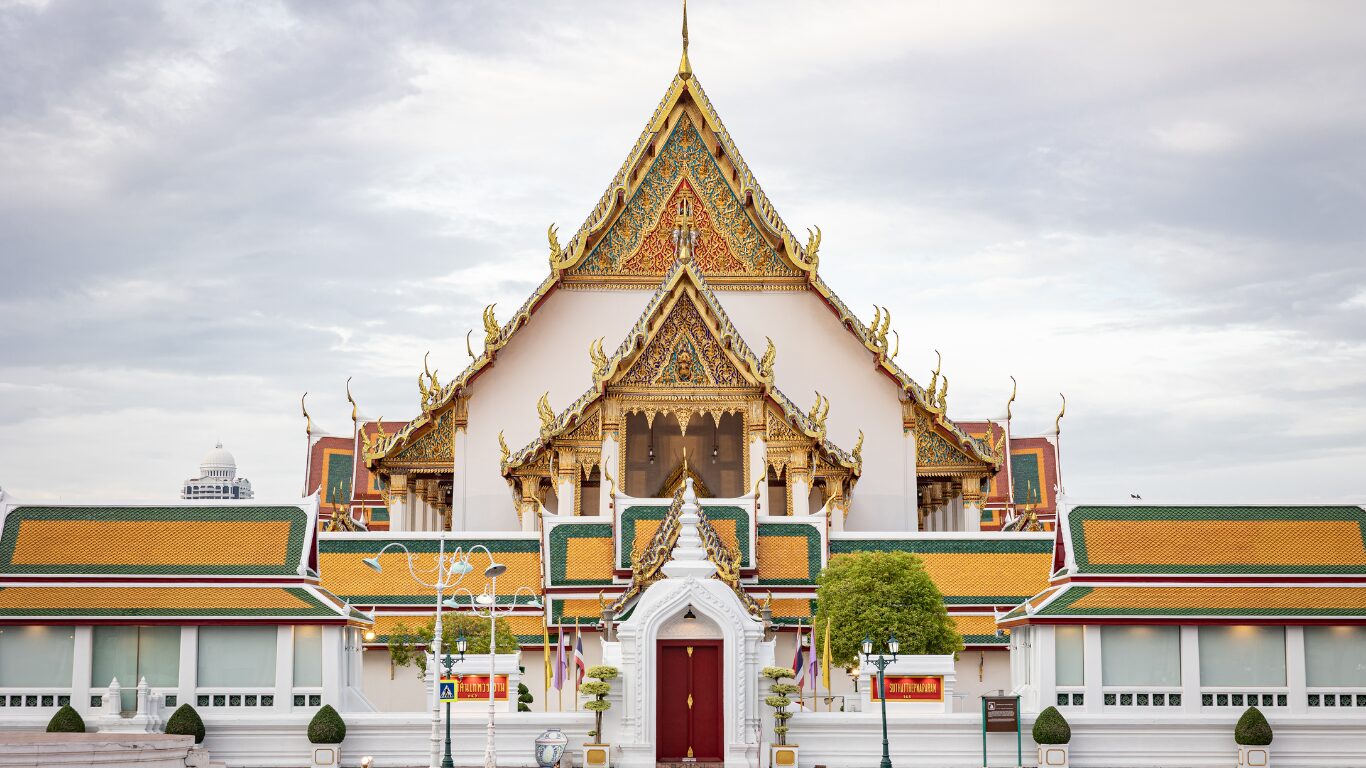
Tha Tien, Phra Nakhon
Wat Pho is Bangkok’s oldest and largest temple complex, predating Bangkok itself. Established during the Ayutthaya period and greatly expanded by King Rama I, it was designated Thailand’s first centre of public education, its stone inscriptions on medicine, literature, and astrology are listed by UNESCO as part of the Memory of the World register.
The Reclining Buddha (46 metres long, 15 metres high) is the largest in Thailand. Its golden surface catches the light differently throughout the day, and the feet, inlaid with 108 mother-of-pearl symbols of the auspicious characteristics of Buddha, are among the most detailed objects in any Bangkok temple.
The temple is also home to a renowned Thai massage school. You can receive a traditional massage on-site after finishing your visit.
- Opening hours: 8:30am–6:30pm daily
- Entry fee: 300 THB
- Address: 2 Sanam Chai Road, Phra Nakhon, Bangkok
- Google Maps: Get Direction
What Thais pray for here: Merit-making, healing, and wisdom. As the historical centre of Thai medicine and education, Wat Pho is associated with knowledge and physical wellbeing.
Getting there with ThaiGo Day Pass: Thai Smile Boat to N8 (Tha Tien Pier), less than 200m to the entrance.
3. Wat Arun: Temple of Dawn
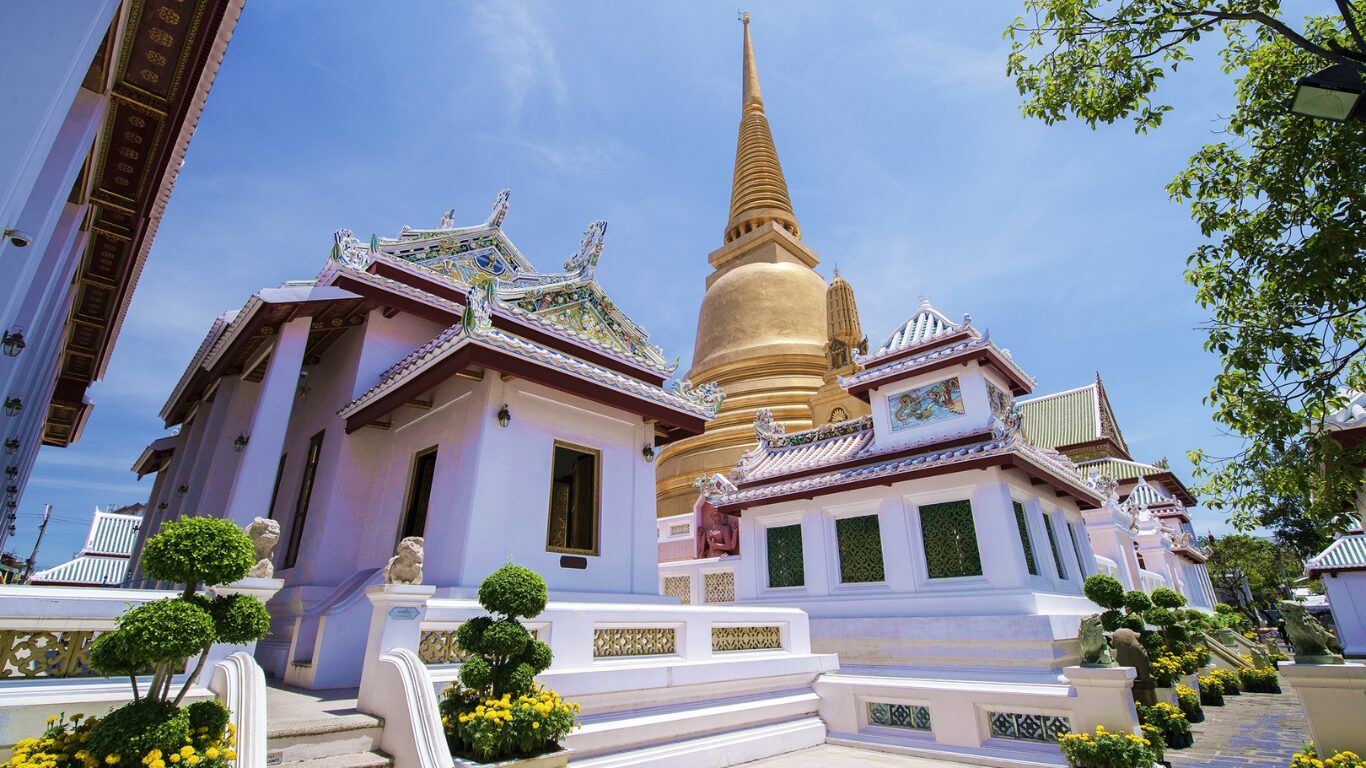
Thonburi, across the Chao Phraya
Wat Arun stands on the west bank of the Chao Phraya, its central prang rising approximately 82 metres above the river, the most recognisable silhouette in all of Bangkok, seen on every riverboat journey through the old city. What makes it unique is the surface: tens of thousands of fragments of Chinese porcelain (originally ballast from trading ships) set into the tower to create an iridescent mosaic that glimmers differently at every hour of day.
The temple dates to the Ayutthaya period but was greatly expanded during the reign of King Rama II and completed under Rama III. Its name comes from Aruna, the Hindu god of dawn, and it was reportedly named after King Taksin arrived at the site at sunrise when founding his Thonburi capital in 1768.
Visitors can climb the steep, narrow staircase of the central prang for panoramic views across the Chao Phraya to the Grand Palace and Wat Pho.
- Opening hours: 8:00am–6:00pm daily
- Entry fee: 200 THB (Thai nationals free with ID)
- Address: 158 Thanon Wang Doem, Wat Arun, Bangkok Yai, Bangkok
- Google Maps: Get Direction
What Thais pray for here: Spiritual renewal, rebirth, and enlightenment. The prang’s symbolism as Mount Meru, the centre of the universe in Buddhist and Hindu cosmology, — makes it a powerful site for prayers of transformation.
Getting there with ThaiGo Day Pass: Thai Smile Boat to N8 (Tha Tien Pier) → cross-river ferry (5 THB, runs every ~10 minutes, 5:00am–7:00pm).
4. Wat Benchamabophit: The Marble Temple
Dusit, central Bangkok
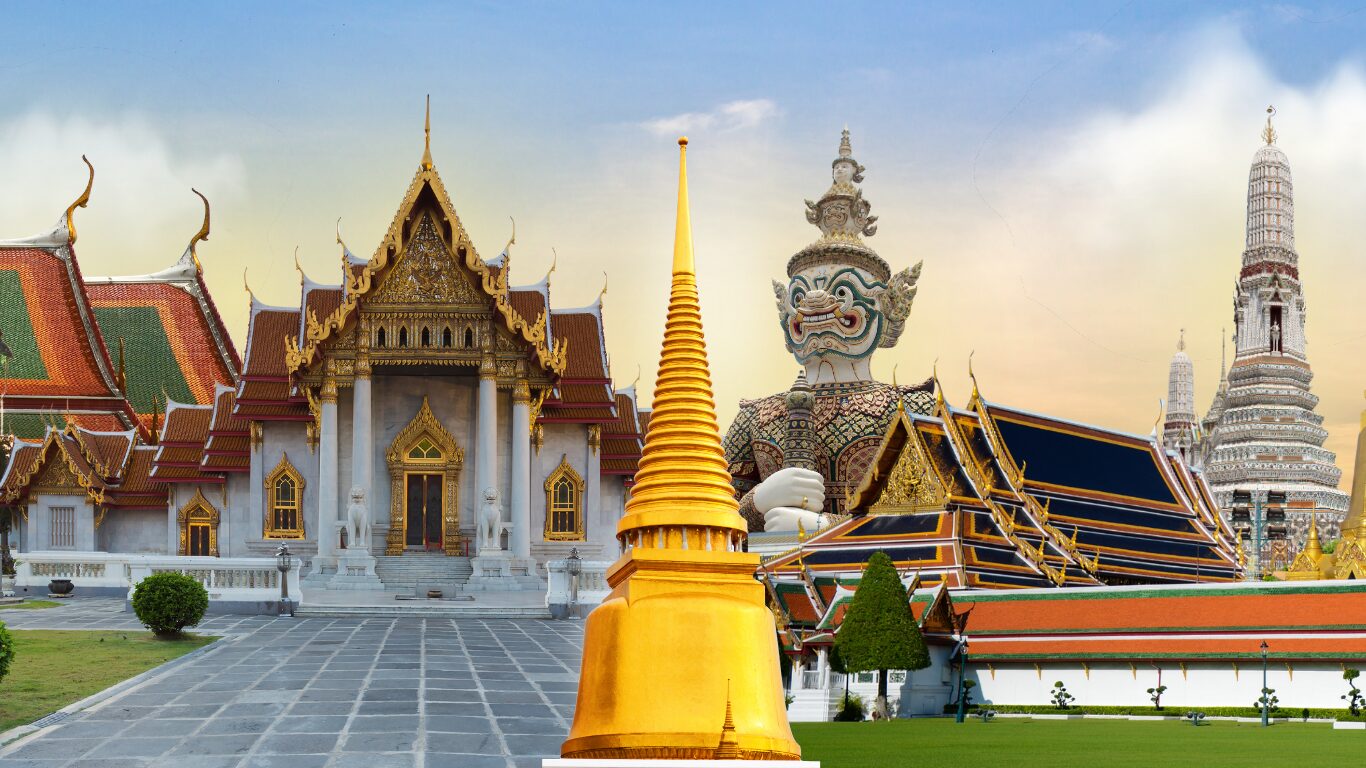
Wat Benchamabophit Dusitwanaram, the Marble Temple, is one of the most architecturally refined Bangkok temples in Thailand. Built in 1899 by King Chulalongkorn (Rama V), the ordination hall is constructed from Carrara marble imported from Italy, giving the temple a luminous quality quite different from Bangkok’s other major temples.
The surrounding gallery holds 52 Buddha images from across Asia, each in a different posture (mudra), a rare collection offering a survey of Buddhist artistic traditions from Thailand, China, Japan, and Cambodia. Behind the ordination hall grows a Bodhi tree grown from a cutting taken from the sacred tree in Bodhgaya, India, the site of the Buddha’s enlightenment.
The temple famously appears on Thailand’s 5-baht coin.
- Opening hours: 8:00am–6:00pm daily
- Entry fee: ~50 THB (confirm at entrance)
- Address: 69 Rama V Road, Dusit, Bangkok
- Google Maps: Get Direction
What Thais pray for here: Spiritual reflection, meditative practice, and merit-making. The Marble Temple is particularly important during Makha Bucha and Visakha Bucha festivals, when candlelight processions circle the ordination hall at night.
Getting there: Take a taxi or Grab from the Grand Palace area (~10 minutes). Not directly on ThaiGo routes.
5. Wat Suthat: Temple of the Giant Swing
Phra Nakhon, Old City
Wat Suthat Thepwararam is one of Bangkok’s finest temples, yet consistently overlooked by visitors focused on the better-known riverside sites. Founded by King Rama I in 1807, the viharn (main hall) is one of the tallest in Bangkok and contains the Phra Sri Sakyamuni Buddha, a revered Sukhothai-period image brought here from Sukhothai after the capital moved to Bangkok.
The handmade teakwood doors, hand-carved with scenes from the Ramakien epic, are among the finest examples of Thai craftsmanship in any Bangkok temple. Outside the entrance stands the Giant Swing (Sao Ching Cha), a 21-metre-tall red teak structure used in a former Brahmin ceremony where participants would swing to great heights to catch bags of gold coins. The ceremony was discontinued in 1932 but the swing remains an iconic Bangkok landmark.
- Opening hours: 8:00am–5:00pm daily
- Entry fee: 20 THB
- Address: 146 Bamrung Mueang Road, Phra Nakhon, Bangkok
- Google Maps: Get Direction
What Thais pray for here: Prosperity, financial stability, and wisdom. The Phra Sri Sakyamuni Buddha is believed to bless devotees with good fortune and intellectual brilliance.
Getting there with ThaiGo Day Pass: Thai Smile Bus 3-1 to the Democracy Monument / Bamrung Mueang area, then a 10-minute walk.
6. Wat Bowon Niwet: The Royal Monastery
Banglamphu, near Khao San Road
Wat Bowon Niwet Vihara is Bangkok’s most significant royal Buddhist monastery, the temple where every king of the Chakri dynasty has served as a monk. King Rama IV (King Mongkut, who inspired The King and I) ordained here; King Bhumibol (Rama IX) served his monkhood here in 1956; and the current King Vajiralongkorn studied the Dhamma within these walls.
For international visitors, it is one of the most authentically spiritual Bangkok temples to visit, far less touristed than the riverside temples, yet deeply significant. The ordination hall contains a rare T-shaped design and holds a Sukhothai-period Buddha image cast in 1257 CE. The early morning monks’ chanting here, at around 6–7am, is one of the most atmospheric experiences in the city.
- Opening hours: 6:00am–6:00pm daily
- Entry fee: Free
- Address: 248 Phra Sumen Road, Banglamphu, Phra Nakhon, Bangkok
- Google Maps: Get Direction
What Thais pray for here: Royal blessings, spiritual study, and protection. As the home temple of Thailand’s kings, it carries authority and significance beyond most other Bangkok temples.
Getting there with ThaiGo Day Pass: Thai Smile Bus 3-1 to the Khao San / Banglamphu area, Wat Bowon Niwet is a 5-minute walk from Khao San Road.
Bangkok Temple Circuit: One-Day Route
The six temples above can be grouped into two natural circuits:
Old City circuit (one day): Wat Phra Kaew → Wat Pho (walk, 15 minutes) → cross river to Wat Arun (ferry, 5 THB) → Wat Suthat (taxi or bus back to Phra Nakhon) → Wat Bowon Niwet (10-minute walk)
Dusit extension (half day): Wat Benchamabophit (taxi from Old City, ~10 minutes), best visited mid-morning before the heat peaks
ThaiGo Day Pass covers: Wat Phra Kaew (Tha Chang), Wat Pho (Tha Tien), Wat Arun (Tha Tien + ferry), Wat Suthat, Wat Bowon Niwet (Bus 3-1). Use a taxi for Wat Benchamabophit.
Get your ThaiGo Day Pass: https://www.hellothaigo.com/day-pass/
Temple Etiquette for International Visitors
Clothing: Shoulders, knees, and ankles must be covered at the Grand Palace. At other Bangkok temples in Thailand, shoulders and knees are the minimum. Lightweight linen trousers and a short-sleeved shirt cover all requirements comfortably.
Shoes: Remove shoes before entering any ordination hall or viharn. Sandals are recommended over lace-up shoes for speed and practicality.
Photography: Photography of temple exteriors and grounds is always permitted. Inside the main halls, follow posted signs, some restrict photography or flash near Buddha images.
Offerings: Flower, incense, and candle sets (15–30 THB) are available at stalls near most temples. Light incense from the flame at the stall, hold in both hands, and bow before the main Buddha image.
Monk interactions: Do not touch monks. Women should not hand objects directly to monks, place items on a cloth or table for them to receive. It is appropriate for visitors of any faith to bow slightly before a Buddha image as a mark of respect.