使用 "JULY75" 优惠码立享75%折扣


Bangkok is not a difficult city. It is a loud, layered, endlessly interesting one, and most of what makes first-time visitors anxious is either overblown or easy to prepare for once you know what to expect.
This guide covers the 15 most important things to know before visiting Bangkok: what to wear at temples, whether to use cash or card, which scams to watch for, how to get around without overpaying, and the cultural rules that are not obvious until you accidentally break them.
For getting around once you arrive, download the ThaiGo app and pick up a ThaiGo Day Pass. It covers unlimited rides on Thai Smile Bus and Thai Smile Boat routes across the city at one flat daily fee, so you can move between temples, markets, and neighbourhoods without negotiating fares or carrying exact change.
Learn more and download the ThaiGo App: https://www.hellothaigo.com/th/
Before You Arrive
Visa
Visa-exempt nationalities: 93 countries | Length of stay: 60 days | Cost: Free
Most visitors to Bangkok arrive without needing to arrange a visa in advance. Thailand’s visa exemption program covers 93 nationalities as of 2025, granting 60 days on arrival at Suvarnabhumi and Don Mueang airports. Your passport must be valid for at least 6 months from your arrival date.
If you plan to stay longer or travel frequently in and out of Thailand, a tourist visa or long-stay visa applied for in advance gives more flexibility. Do not overstay, as Thailand charges 500 THB per day and stamps your passport, which can affect future entry applications.
Visitor tip: Check the Thai e-Visa portal (thaievisa.go.th) before travel. Requirements change, and some nationalities have been added or adjusted since the 2024 visa policy update.
SIM Card
Best place to buy: Airport arrivals hall | Cost: 200 to 500 THB | Data: 15 to 30GB for 7 to 30 days
Buy a Thai SIM card the moment you land. AIS, DTAC, and True Move all have counters in the arrivals halls at both Bangkok airports. The staff will insert and activate the card for you. Prices are low, coverage is excellent, and having data from minute one means the ThaiGo app, Grab, Google Maps, and translation apps are all ready before you leave the terminal.
Do not buy SIM cards from airport taxi touts or street sellers outside the arrivals hall. The legitimate counters are clearly signposted inside the terminal building.
Visitor tip: AIS and True Move offer tourist SIM packages with unlimited data for 7 days from around 299 THB. Buy more days than you think you need, since the cost difference is minimal.
Cash
Currency: Thai Baht (THB) | ATM fee: 220 THB per foreign transaction | Best rate: Exchange booths in city, not airport
Cash is not optional in Bangkok. It is essential. Street food stalls, canal boats, night markets, smaller temples, tuk-tuks, and most local restaurants only accept cash. You can survive on a card in malls and large hotels, but you will miss the city’s best parts if you run out of baht.
The airport exchange rate is the worst you will find in Bangkok. Withdraw from ATMs at the airport to cover your first day, then use exchange booths at SuperRich (Siam and Asok locations) or Vasu Exchange for significantly better rates on your remaining cash needs. Most foreign bank cards incur a 220 THB flat fee per ATM withdrawal, so withdraw in larger amounts to minimize fees.
Visitor tip: Keep small bills (20 and 50 THB notes) for street food, boat fares, and small purchases. Vendors often cannot give change for 500 or 1,000 THB notes.
Getting Around Bangkok
BTS, MRT, and Boat
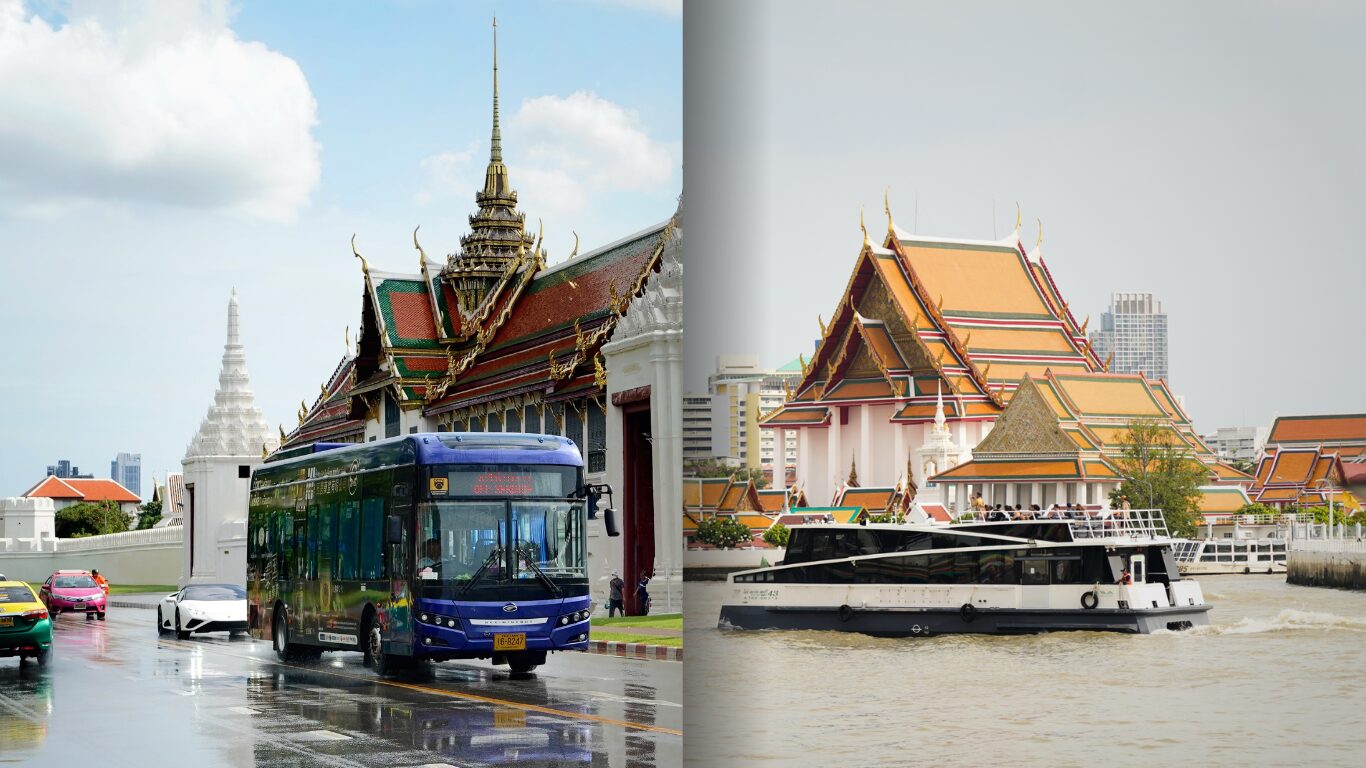
BTS Skytrain fares: 17 to 59 THB | MRT fares: 17 to 42 THB | Thai Smile Boat: Covered by ThaiGo Day Pass
Bangkok traffic is legendary. The expressways and side streets that look short on a map can take 40 to 60 minutes by taxi during peak hours. The BTS Skytrain (elevated rail) and MRT (underground) bypass all of it. For most tourist routes including Siam, Silom, Sukhumvit, and Chatuchak, the rail network is faster than any road-based option.
For riverside destinations like the Grand Palace, Wat Pho, Wat Arun, Chinatown, and the flower market, the Chao Phraya Express Boat and Thai Smile Boat are faster than both rail and road. The river cuts through the centre of the old city in a way the BTS does not reach.
Getting there with ThaiGo: The ThaiGo Day Pass covers unlimited Thai Smile Bus and Thai Smile Boat rides across Bangkok. One flat daily fee for the entire network, with no tokens, no fares, and no negotiating. Open the ThaiGo app, tap Day Pass, and every route on the network is yours for the day.
Grab vs Taxis
Grab: Fixed price, tracked, reliable | Metered taxis: Unreliable for tourists | Tuk-tuks: Tourist experience, not transport
Use Grab. The app shows the price before you confirm, your route is tracked, and the driver has no incentive to take detours. It is not meaningfully more expensive than a metered taxi, and the experience is significantly less stressful.
Metered taxis in Bangkok are technically supposed to use the meter. In practice, many drivers outside major hotels will quote flat rates to tourists, especially near popular attractions. If a driver refuses the meter, get out and open Grab. Tuk-tuks are genuinely fun for one short scenic ride around the Grand Palace area or along the riverside, but at 200 to 400 THB for a 10-minute trip, they are not a transport solution.
Visitor tip: Set your Grab pickup point carefully in busy areas like Siam and Asok, as drivers will message you if they cannot find the exact spot. Keep your phone charged.
Money and Payments
What Costs What
Budget per day: 800 to 1,500 THB (mid-range) | Street meal: 50 to 100 THB | Taxi across town: 80 to 150 THB | Temple entry: 100 to 500 THB
Bangkok is excellent value by almost any international standard. A full meal at a street stall costs 50 to 80 THB. A massage runs 250 to 400 THB per hour. Even mid-range hotels in Sukhumvit come in at 1,200 to 2,500 THB per night.
The Grand Palace is the notable exception at 500 THB entry, which is the highest single admission price for any Bangkok attraction. Wat Pho charges 200 THB. Most neighbourhood temples are free. Budget accordingly if temple-hopping is a priority, as costs add up across a day.
Visitor tip: 7-Eleven is your friend. There are more than 2,000 branches in Bangkok. They accept cards, have clean ATMs, sell prepaid top-ups, and stock everything from cold water to decent ready-made meals for 40 THB.
Temples, Dress Codes, and Cultural Respect
Temple Etiquette
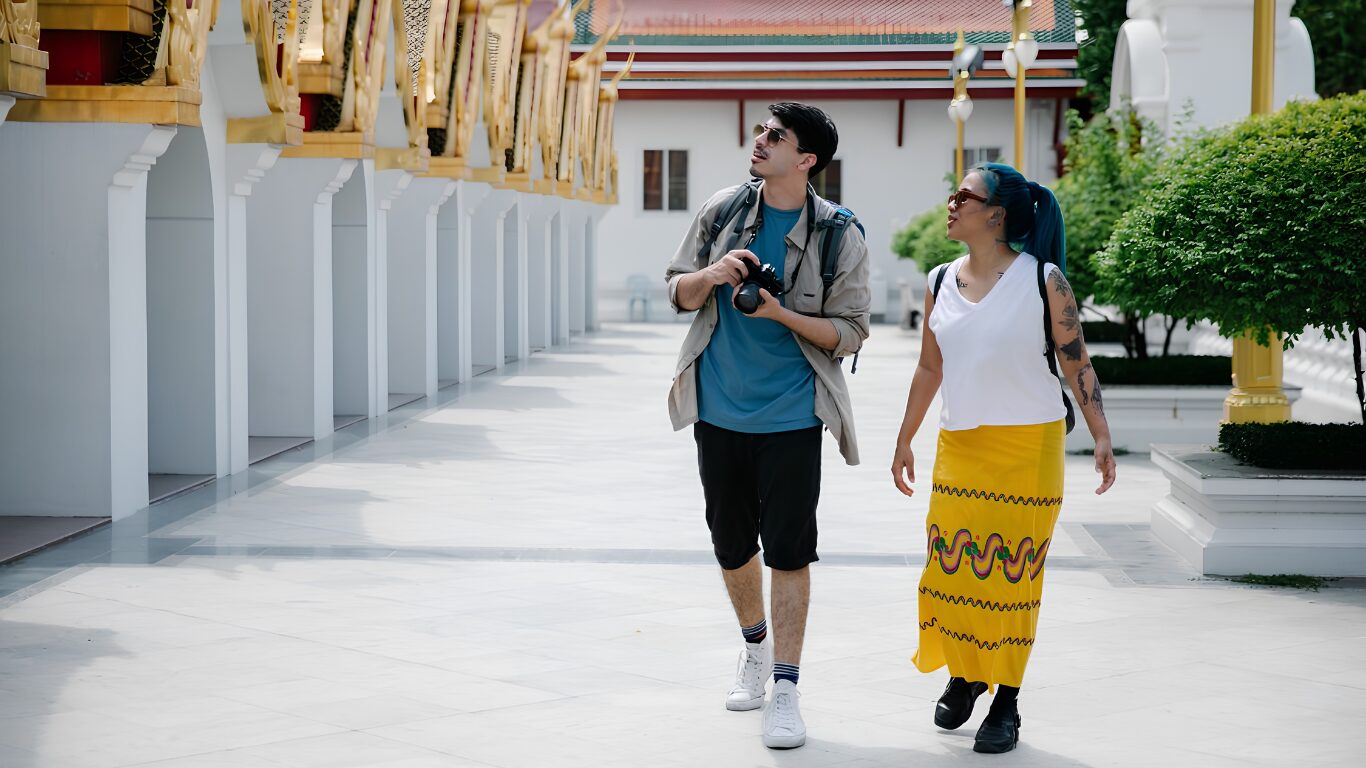
Dress requirement: Shoulders and knees covered | Shoes: Removed before entering main halls | Photography: Permitted in most areas, not during active prayer
Bangkok has more than 400 Buddhist temples. Most are open to visitors, and most require the same basic preparation: covered shoulders, covered knees, and shoes left outside the main building. This applies to everyone, regardless of gender, age, or the heat outside.
Many temples keep sarongs and wraps near the entrance for visitors who arrive underprepared. Using them is fine. Wearing them incorrectly (sarong draped over shorts that end above the knee) will get you turned away at the Grand Palace and Wat Pho, which enforce the dress code strictly.
Early morning visits before 9am are cooler, less crowded, and often more atmospheric. Monks complete their morning routines in the early hours, and the temple compounds feel completely different before the tour groups arrive.
Getting there with ThaiGo: Take the Thai Smile Boat to N9 (Tha Chang Pier) for the Grand Palace and to N8 (Tha Tien Pier) for Wat Pho. Both stops are covered by the ThaiGo Day Pass, and you can do both temples back to back with a single 10-minute boat ride between them.
Visitor tip: A lightweight linen shirt and cotton trousers work for both temple visits and Bangkok’s heat. Pack one outfit that covers you from shoulder to ankle and you can access anywhere in the city without rethinking your wardrobe.
Cultural Rules That Matter
Key rules: Don’t touch monks | Don’t point feet at people or shrines | Don’t raise your voice | The monarchy is not a topic for jokes
Thai culture operates on a framework of respect, face, and calm that differs significantly from many Western defaults. Loud expressions of frustration at a taxi driver, in a restaurant, or over a billing dispute create public embarrassment that makes everything worse. The same problem handled quietly and politely gets resolved faster.
The Thai monarchy is protected by lèse-majesté laws, which carry a prison sentence of 3 to 15 years per count. This is not theoretical, as tourists have been charged and convicted. Keep commentary about the royal family entirely private.
Women should not touch or hand objects directly to monks. If you need to give something to a monk, place it on a surface for them to pick up, or hand it to a man accompanying the monk.
Visitor tip: The wai, palms pressed together at chest height with a slight bow, is the standard greeting. You do not need to initiate it, but returning one when it is offered is always appreciated.
Bangkok Scams: What to Watch For
“Grand Palace is closed today”: A friendly stranger tells you the palace is closed for a ceremony and offers to take you somewhere else, usually a gem shop. The Grand Palace closes only for state funerals and rare royal events. Ignore the person and walk in yourself.
Gem shop pressure: A tuk-tuk driver offers a very cheap fare and then routes you through a “government gem export sale” where dealers pressure you into purchases of questionable quality. Never accept a tuk-tuk fare that seems too cheap, as there is always a detour attached.
Taxi meter refusal: The driver quotes a flat fare from the airport or near popular attractions instead of using the meter. Insist on the meter. If refused, get out and use Grab.
Friendly stranger at temples: Someone approaches claiming the temple is free “for locals today” and offers to show you around, earning commissions from shops along the way. Politely decline. Entry fees are standard and guides who approach tourists unsolicited almost always have a shop stop built into the tour.
Jet ski damage scam: More relevant to beach areas outside Bangkok, but worth knowing before your wider Thailand trip. You return a jet ski and are charged for damage that was already there. Do not rent from informal vendors outside supervised areas on any Thai beach.
Food and Street Eating
Street Food in Bangkok
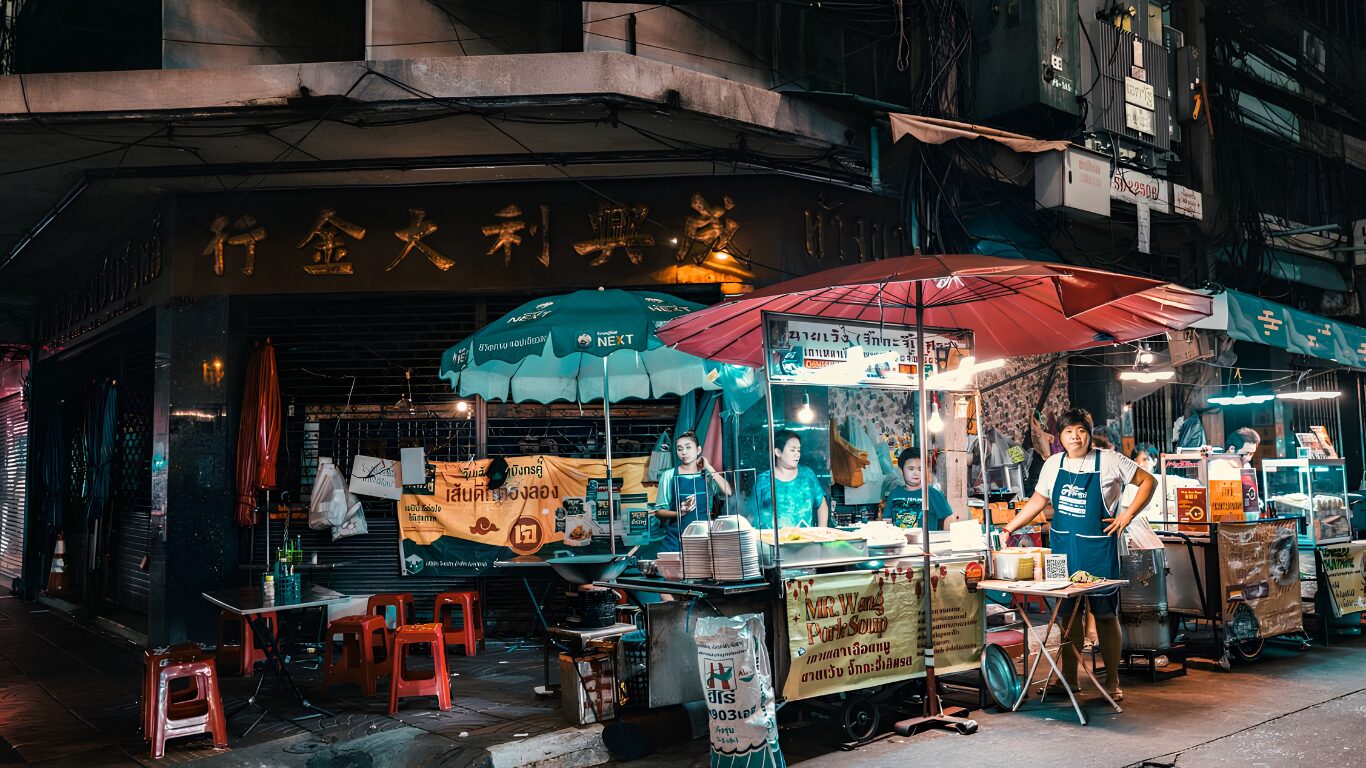
Average street meal: 50 to 80 THB | Best areas: Yaowarat (Chinatown), Or Tor Kor Market, Chatuchak, any soi with a queue
Bangkok’s street food is some of the safest, most consistent, and most delicious in the world. The hygiene concern that many first-time visitors carry from home does not match the reality. Vendors who cook in front of you, serve high turnover volumes, and have lines of local customers are overwhelmingly safe to eat at.
The indicators that matter: a crowd of Thai people, fresh ingredients visible on the cart, food cooked to order rather than sitting under heat lamps, and a clean cooking setup. A plastic stool outside a shophouse serving pad see ew for 60 THB is not a risk. It is lunch.
Pad Thai, khao man gai (chicken rice), boat noodles, mango sticky rice, and grilled pork skewers are all safe starting points. If you have a sensitive stomach, avoid raw shellfish from street stalls and ice from unclear sources for the first day or two while you adjust.
Getting there with ThaiGo: Take Thai Smile Bus 2-38(8) or 3-45(77) directly to Chatuchak Weekend Market, which is a 5-minute walk from Or Tor Kor Market. Both routes are covered by the ThaiGo Day Pass. For Chinatown, take the Thai Smile Boat to N6 (Memorial Bridge Pier) and walk 3 minutes to Yaowarat Road.
Visitor tip: Or Tor Kor Market near Chatuchak is Bangkok’s premium fresh market, exceptionally clean, covered, and excellent for trying regional Thai ingredients and prepared food at fair prices.
Safety and Health
Is Bangkok Safe?
Crime rate: Low for tourists | Main risk: Scams and petty theft, not violence | Solo travel: Very manageable including at night
Bangkok is genuinely safe by the standards of any major city. Violent crime against tourists is rare. Solo travelers, including solo women, navigate the city routinely without incident. The areas most tourists visit (Sukhumvit, Silom, Siam, the riverside) are well-lit, active at night, and monitored.
The risks that do exist are scams (covered above), traffic (motorbike taxis and uneven pavements cause more tourist injuries than crime), and heat-related dehydration. Cross roads cautiously, as Bangkok drivers run late amber lights and motorbike lanes appear without warning.
Healthcare in Bangkok is excellent. Bumrungrad International, Bangkok Hospital, and Samitivej are world-class private hospitals with English-speaking staff. Travel insurance that covers medical is strongly recommended, especially if you plan to ride motorbikes or do activities outside the city.
Visitor tip: Keep a photocopy of your passport rather than carrying the original. Bangkok’s hospitals require a passport number for registration, and a photo on your phone works equally well while keeping the original in your hotel safe.
Quick Guide: What Kind of Bangkok Traveler Are You?
First-time visitor with limited time: Stay in Sukhumvit (Asok or Phrom Phong area). Use the BTS for main routes and the ThaiGo Day Pass for riverside and old town destinations. Visit the Grand Palace, Wat Pho, and Chatuchak on separate days. Eat street food at every meal.
Budget traveler: Khao San Road for accommodation (noisy but cheap). Use the Thai Smile Bus network via the ThaiGo app for transport. Or Tor Kor and Chatuchak markets for food. Aim for 800 to 1,200 THB per day including accommodation.
First trip, nervous about logistics: Book a centrally located hotel near a BTS station. Download the ThaiGo app and Grab before landing. The ThaiGo app covers all Thai Smile Bus and Boat routes from day one, and everything else figures itself out within 24 hours of arriving.
Repeat visitor or longer stay: Move off the tourist belt to areas like Ari, Phra Khanong, Thonglor, and Lat Phrao, which offer more local Bangkok without the premium. Use the Thai Smile Boat network via ThaiGo for the old city.
Traveling with family or elderly relatives: Riverside hotels near N9 (Tha Chang Pier) minimize walking distances to the main temple sites. Avoid peak midday heat (11am to 3pm) entirely. The ThaiGo Day Pass covers boat routes that put the Grand Palace and Wat Pho within 5 minutes of each other, with no stairs or traffic to deal with.
Sensitive to heat or rain: November to February only. Book 6 to 8 weeks in advance for December. See the Bangkok weather by month guide for detailed month-by-month planning.
Getting Around Bangkok with ThaiGo
All routes below are included in the ThaiGo Day Pass. Download the ThaiGo app, activate your pass, and every bus and boat listed here is covered for the day.
Grand Palace and Wat Phra Kaew: Thai Smile Boat to Tha Chang Pier
Wat Pho: Thai Smile Boat to Tha Tien Pier
Wat Arun: Thai Smile Boat to Wat Arun Pier
Chinatown and Yaowarat: Thai Smile Boat to Memorial Bridge Pier
Chatuchak Weekend Market: Thai Smile Bus 2-38(8) or 3-45(77)
Or Tor Kor Market: Thai Smile Bus 2-38(8), same stop as Chatuchak
Khao San Road: Thai Smile Bus 3-1
Lumpini Park: Thai Smile Bus 1-18E (Silom Road)
Jim Thompson House: Thai Smile Bus 3-11 (48)
Pak Khlong Talat (Flower Market): Thai Smile Boat to Rajinee Pier, 3-minute walk
Get your ThaiGo Day Pass: https://www.hellothaigo.com/day-pass/
Practical Reminders
Cash: Carry 500 to 1,000 THB in small bills at all times. ATMs charge 220 THB per foreign withdrawal, so withdraw in larger amounts.
Dress code: One outfit that covers shoulders and knees gets you into every temple in Bangkok without scrambling for a borrowed sarong.
Heat: Plan outdoor sightseeing before 11am and after 4pm. Carry water. The ThaiGo canal boat between temples is significantly cooler than walking in direct sun.
Scams: If any stranger approaches you near a major attraction to tell you it is closed, redirect you, or offer an unusual deal, decline and keep walking.
Shoes: Remove before entering any temple hall, Thai home, or traditional Thai massage shop. Slip-on shoes make this significantly faster across a full sightseeing day.
Language: Thais appreciate any attempt at Thai, however brief. “Khob khun kha/khrap” (thank you) and “sawasdee kha/khrap” (hello/goodbye) go a long way. Google Translate’s camera function handles Thai menus instantly.
7-Eleven: Open 24 hours, everywhere. ATM, cold water, phone charging cables, and a surprisingly good selection of ready meals. Use it freely.